
For a 1/10 basher, build a plywood ramp about 36 x 36 inches at 20 to 30 degrees, or buy a folding steel ramp if you need to carry it to a park. For 1/16 to 1/24 trucks, a small plastic ramp is cheap and does the job. Whichever you choose, plan the landing first. Ramps don't break trucks. Flat, hard landings do.
Quick picks
| Best ready-made ramp for 1/10 bashers | YSKMLOLP folding RC jump ramp, 100 x 80 cm | Amazon |
|---|---|---|
| Best adjustable angle | 911 Motorsports 2 x 4 ft RC ramp frame (1:10) | Amazon |
| Best compact folding ramp | Folding RC jump ramp, 50 x 60 cm | Amazon |
| Best for small trucks | Snap-together plastic RC ramp for 1/12 to 1/24 | Amazon |
| Best for 1/24 monster trucks | Jeff Did It! 1/24 monster truck stunt ramp A | Amazon |
| Best for building a landing | Elevate Outdoor Mini EZ-Link ramp set | Amazon |
| Best ramp to share with bikes | Andjoor kids jump ramp, 25.2 in | Amazon |
How we picked these ramps
We searched Amazon for RC car ramps on Oct 21, 2026, sorted by bought-last-month counts and rating history, and dropped bike and skate ramps that RC owners don't actually use. Ramp sizes and angles below come from each product listing. The build plan is ours, put together from the guides that rank for this topic: RC Visions' ramp guide, Dickie Toys' DIY ramp article, the Hobbico track instructions RC Car Action republished, an RCTalk thread where a member designed a ramp for 1/10 and 1/8 trucks, FairRC's product page and 911 Motorsports' Amazon listing. An Instructables folding-ramp build wouldn't load for us, so the one rule we take from it comes from its search summary. We haven't jumped these ramps ourselves, and the cards say so. How we research.
Size the ramp to the truck
The simplest rule we found is in the search summary of an Instructables folding-ramp build: the ramp should be at least one and a half times as long as the car and three times as wide. Length keeps both axles on the ramp for a moment at launch, so the truck leaves level instead of nose-down. Width lets you hit it at an angle without dropping a wheel off the edge. Here's what that rule works out to:
| Scale | Example truck (listed size) | Deck length | Deck width | Plywood | Ribs |
|---|---|---|---|---|---|
| 1/24 | Axial SCX24, about 7.8 x 3.9 in | 12 in | 12 in | 1/2 in | 2 |
| 1/16 to 1/18 | Traxxas Mini Slash, 16 x 8.5 in | 24 in | 28 in | 1/2 or 3/4 in | 3 |
| 1/10 | Traxxas Slash 4X4, 22.4 x 11.7 in | 36 in | 36 in | 3/4 in | 3, 18 in apart |
| 1/8 | Traxxas Sledge, 23.8 in long | 48 in | 48 in | 3/4 in | 4, 16 in apart |
Truck sizes are from retailer and Amazon listings. The 18-inch rib spacing for 1/10 matches the RCTalk member's build, and RC Visions recommends 3/4 in plywood or thicker, exterior grade or sealed, for anything that will be jumped hard. One RCTalk poster who used thin underlayment says bigger trucks punched through it.
Pick the angle
A shallow ramp sends the truck long and low. A steep one sends it high, and higher means a harder landing. The sources don't agree on one number, which makes sense, because they're aiming at different jumps:
| Source | Angle | What it's for |
|---|---|---|
| RC Visions ramp guide | 20 to 35° | "Optimal" for most 1/10 and 1/8 cars |
| RCTalk member's 1/10 and 1/8 build | About 45° | Gentle, slow jumps for practicing flat landings |
| 911 Motorsports listing | 40° | Long kicker; the listing claims 20 to 40 ft jumps |
| 911 Motorsports listing | 50° | High jumps; it claims "well over 10' high" |
| 911 Motorsports listing | 60° | Backflips at low and medium speed |
Our advice: build your first ramp at 20 to 25 degrees. You'll get distance you can actually land, and you can always prop the back up later.
Build a plywood kicker
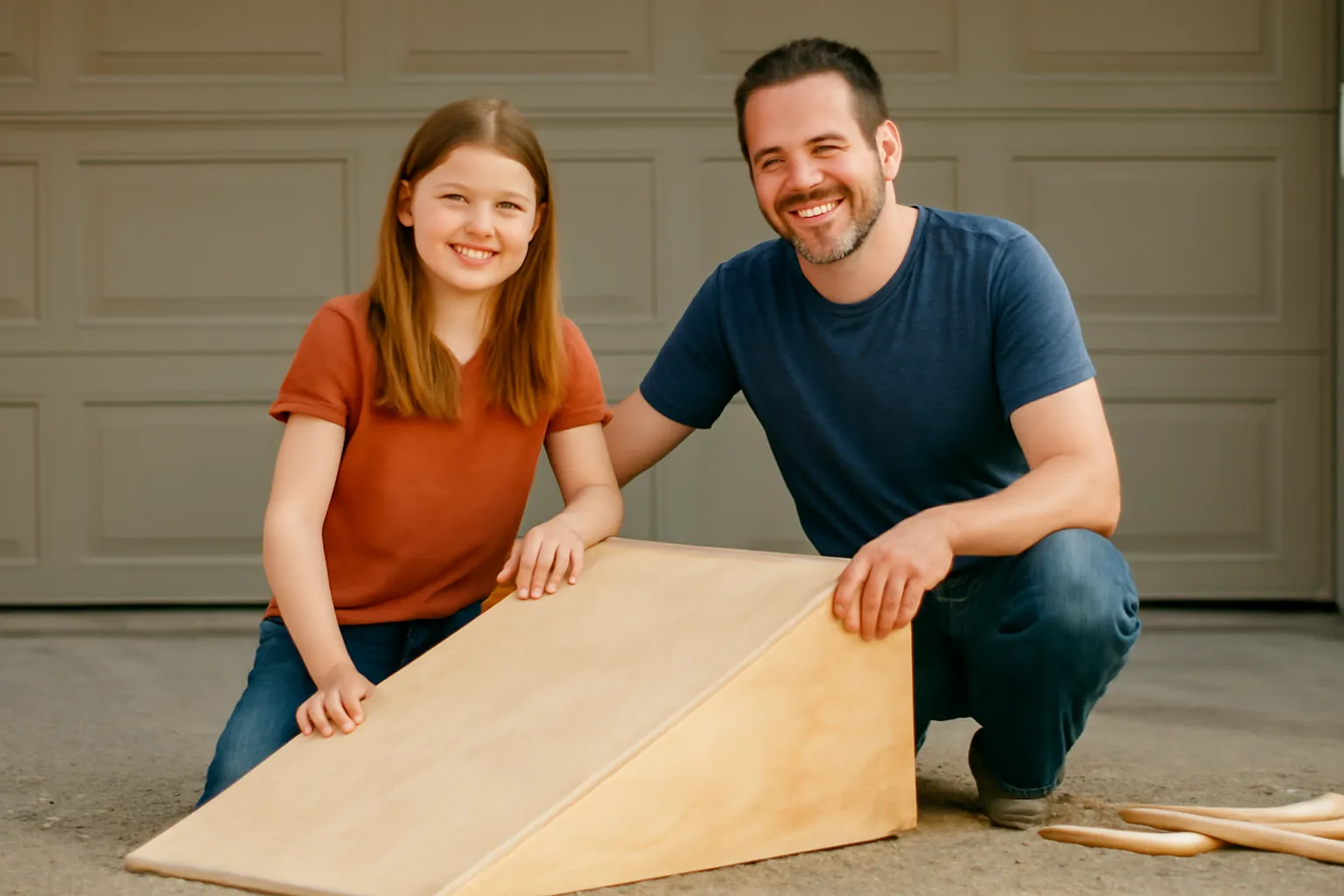
This is a straight wedge: three or four triangular ribs, a deck on top, a panel across the back. It takes an afternoon and a circular saw or jigsaw.
Cut each rib to these numbers. L is the deck length from the sizing table, measured along the slope.
| Deck length L | 20°: rise / run | 30°: rise / run | 40°: rise / run |
|---|---|---|---|
| 12 in (1/24) | 4.1 / 11.3 in | 6.0 / 10.4 in | 7.7 / 9.2 in |
| 24 in (1/16 to 1/18) | 8.2 / 22.6 in | 12.0 / 20.8 in | 15.4 / 18.4 in |
| 36 in (1/10) | 12.3 / 33.8 in | 18.0 / 31.2 in | 23.1 / 27.6 in |
| 48 in (1/8) | 16.4 / 45.1 in | 24.0 / 41.6 in | 30.9 / 36.8 in |
Build steps for the 1/10 version:
- Cut three ribs from 3/4 in exterior plywood for the angle you want, then a 36 x 36 in deck and a back panel 36 in wide and as tall as the rise.
- Stand the ribs 18 in apart, one at each edge and one in the middle, and screw the back panel across their tall ends.
- Screw the deck down into all three ribs. Thicker trucks need more support, and RCTalk posters suggest extra cross braces under the deck between the ribs if it flexes.
- Sand the front edge thin and round it. A square lip catches the front tires.
- Staple low-pile carpet over the deck so it hangs 6 to 8 inches past the front edge onto the ground. That's the trick from the Hobbico track plans, and it smooths the step from ground to ramp. Dickie Toys lists rubber mat or anti-slip film as other grip surfaces.
- Paint or seal it if it lives outside.
For a 1/24 truck the same design works in 1/2 in plywood, or skip the wood: a hardcover book under a clipboard makes a fine first kicker. For 1/8, use four ribs at 16 inches and consider a second layer on the deck; 911 Motorsports tells 1/8 owners to double the Masonite on its frame for the same reason.
Plan the landing first
Most broken parts come from the landing, not the takeoff. A truck that drops onto flat pavement takes the whole hit through its suspension and driveline. Three ways to make landings easier on the truck:
- Land on a downslope. A second wedge facing away from the kicker, or a dirt mound, lets the truck carry its speed instead of stopping dead. A gap between two ramps with a flat top in the middle (a tabletop) is the forgiving version: come up short and you land on the table, not the edge.
- Land on something soft. RC Visions suggests grass, gym mats or a low second ramp; grass beats concrete every time.
- Land flat. An RCTalk poster sums up air control in five words: "Brake brings down front / Gas brings down rear." Touch the brake if the nose is high, give it throttle if the nose is dropping, and aim to land all four wheels at once.
Also give it room. If the 911 Motorsports claim of 20 to 40 foot jumps off a 40 degree ramp is close for your truck, the landing zone needs to be at least that long and empty, plus run-off past it.
Safety rules for jumping
Nobody stands in the landing zone or in line with the ramp. Ever. Never jump toward a street, parked cars, windows or a crowd. Pin the ramp down, because a ramp that slides at takeoff throws the truck sideways: RC Visions suggests sandbags outdoors and anti-slip pads on hard floors, and 911 Motorsports says high-speed hits need dirt packed behind the ramp or sandbags. Check the ramp for cracks and loose screws after every session, as Dickie Toys advises, and fix it before the next one. The largest ramp in our list carries a 15+ age range on its listing; a hobby truck running a LiPo has its own age grade, so read the box.
The best RC car ramps to buy
YSKMLOLP folding RC jump ramp, 100 x 80 cm
This was the ramp RC owners bought most on Amazon on Oct 21, 2026 (1,000+ in the past month). It's 39 inches long and 31.5 inches wide, which clears our sizing rule for a 1/10 short course truck, and the back sets to three heights. It folds in half to carry. Two of the same model can be strapped together with hook-and-loop or straps, per the listing. The listing says to use the maker's bigger 100 x 95 cm version for 1/5 trucks. We haven't jumped it; the 86 ratings are shared with several size variants on the same listing.
- Open size100 x 80 cm (39.4 x 31.5 in)
- Heights35, 37 or 40 cm
- Folded50 x 80 x 15 cm
- Weight6 kg (13.23 lb)
- Listed scales1/8 to 1/16
Why it stands out
- Big enough for 1/10 and listed for 1/8
- Three heights, folds for the car
Think twice if
- Your 1/5 truck needs the larger version
- You want to set a specific angle; the listing gives heights, not degrees
911 Motorsports 2 x 4 ft RC ramp frame (1:10)
A frame only: you buy a 2 x 4 ft sheet of 1/8 in Masonite at a home store, or 1/8 in Lexan if you bash hard, and screw it on. Assembly takes 30 to 40 minutes per the listing. In return you get a 48-inch-wide deck you can hit from any angle and legs that set it from 40 to 60 degrees. The maker says it's best for 1/10 and works up to 1/8. Note its range starts at 40°, steeper than we'd suggest for a first ramp. Only 12 ratings so far.
- Deck24 x 48 in (you supply it)
- Angles40 to 60°
- Framealuminum, made in USA
- Folds to5 in tall
- Weight10-15 lb depending on deck
Why it stands out
- Widest deck here; hard to miss
- Angle range for distance, height or flips
Think twice if
- You want a ramp out of the box; the deck isn't included
- You want a gentle 20 to 30° ramp
Folding RC jump ramp, 50 x 60 cm
The same family of ramp as our top pick, in a size that fits under a car seat. At 19.7 inches long it's short for a full-size 1/10 truck by our rule, so we'd put it in front of 1/16 to 1/12 trucks even though the listing names scales up to 1/6. It weighs under 5 pounds. Its rating count is shared with the bigger version.
- Open size50 x 60 cm (19.7 x 23.6 in)
- Height19 to 22.5 cm
- Folded50 x 60 x 12 cm
- Weight2.1 kg (4.63 lb)
Why it stands out
- Light enough for a backpack trip to the park
- Adjustable height
Think twice if
- You drive a 1/10 or bigger truck; get the 100 x 80 cm
Snap-together plastic RC ramp for 1/12 to 1/24
For a 1/18 or 1/24 truck, a heavy ramp is overkill. This plastic one snaps together and folds flat, and it sold 50+ last month. The listing asks you to compare its pictured dimensions with your truck before buying, which is good advice for any ramp. Its rating sits at 3.9 across 102 reviews, lower than we'd like, so treat it as a cheap starter.
- Materialhigh-strength plastic
- Listed scales1/12, 1/14, 1/16, 1/18, 1/24
- Setupsnap-together, folds flat
Why it stands out
- Small and quick to set up
Think twice if
- Rating is middling
- The listing doesn't print its size in the text
Jeff Did It! 1/24 monster truck stunt ramp A
A small printed kicker sized for 1/24 monster trucks like the Monster Jam RC models, with rubber feet so it stays put on a hard floor and a shape that doubles as a display stand. The maker sells other shapes, including a roll-over ramp and a five-ramp set. It's 3.15 inches tall, so check your truck's wheelbase against the 7.87-inch length.
- Size200 x 200 x 80 mm (7.87 x 7.87 x 3.15 in)
- Feetanti-slip rubber
Why it stands out
- Sized for 1/24 trucks
- Rubber feet for indoor floors
Think twice if
- Too small for anything bigger than 1/24
Elevate Outdoor Mini EZ-Link ramp set
Bought mostly by skaters, but it solves the landing problem better than any RC-only ramp here. The pieces link into a kicker, a flat tabletop and a down-slope, so a 1/10 truck can launch, clear the table and land going downhill. At 10.25 inches tall it's a low set for big trucks, and at 19.5 inches wide it's narrow for a 1/10 truck by our rule. The kids can use it on their scooters when you're done.
- Pieces4 mini ramps, 4 slopes, 2 tabletop connectors
- Configurations20
- Materialpolypropylene
- Capacity600 lb
- Size68.5 x 19.5 x 10.25 in
Why it stands out
- Builds a kicker with a tabletop landing
- Rated to 600 lb
Think twice if
- Narrow for 1/10 trucks
- 29 lb to carry
Andjoor kids jump ramp, 25.2 in
A bike and scooter kicker that lists RC cars among its uses and had 200+ buyers last month, with 616 ratings. The 24-inch width suits 1/16 trucks and is about right for a 1/10 by our rule; the 8-inch height over a 26-inch length makes it a gentle ramp, a good thing for learning. Assembles without tools.
- Size26 x 24 x 8 in
- Materialwood
- Weight4.6 kg
- Feetnon-slip rubber
Why it stands out
- Gentle angle for practice
- Long rating history
Think twice if
- You want big air; it's only 8 inches tall
Buy or build: quick comparison
| Option | Best for | Carry it? | Angle | Lasts |
|---|---|---|---|---|
| Folding steel ramp (100 x 80 cm) | 1/10 at the park | Yes, 13 lb folded | 3 heights | Steel frame |
| Aluminum frame (911 Motorsports) | 1/10 to 1/8, flips | Yes, 10-15 lb | 40 to 60° | Swap the deck |
| Plastic ramp (snap-together) | 1/12 to 1/24 | Easily | Fixed | Light use |
| Plywood kicker (build) | 1/10 and 1/8 at home | Heavy | Any you cut | Years if sealed |
| Dirt tabletop (build) | A backyard track | No | Any you shape | Needs re-packing |
Building a full track around your jump? Our guide to building an RC track covers lane widths and drainage.
Which trucks jump well, and what breaks
4WD monster trucks are the easiest to jump: they have the suspension travel and big tires to soak up a landing. Our best RC monster trucks guide picks by space and budget. After a day of jumping, check the shock caps and arms first, then the driveshafts and servo saver. When something does break, replace it with something stronger; the first 5 upgrades for any basher lists what usually goes, and Granite owners can go straight to our Arrma Granite upgrades. A rotating RC work stand (1,400+ ratings) and decent drivers from our RC tool kit guide make those repairs quicker. Ramps also make a good present; see gifts for RC car lovers.
If you buy one thing, buy the 100 x 80 cm folding ramp for a 1/10 truck. If you have a free afternoon and a sheet of plywood, build the kicker at 20 degrees, and build the landing before you build the second one.
Sources: RC Visions, "RC Car Ramp" guide; Dickie Toys, "Build your own RC ramp"; Hobbico DIY track instructions via RC Car Action; Instructables "Quick and Easy Folding RC Ramp" (search summary only); RCTalk "Ramp for 1/10 and 1/8, design help" thread; FairRC product page; 911 Motorsports Amazon listing; Amazon listings checked October 21, 2026. How we research · Affiliate disclosure