
Enter your motor and battery, then the gearing, and the calculator works out the final drive ratio and rollout before the top speed. It shows two speeds: the theoretical no-load number every other RC calculator gives, and a real-world estimate using an efficiency factor you can see and change.
Pick a model from the preset list to load its stock gearing and internal ratio, plus the motor's kV, from the manufacturer's manual. Each preset names the page it came from. Presets cover only models whose manuals publish the numbers we need, so the list is short on purpose; anything else works with Custom.
Pinion swap table (same spur and battery)
| Pinion | FDR | Theoretical | Real-world est. | Change vs current |
|---|
Theoretical speed assumes no load, no drivetrain losses and a perfectly round tire. The real-world figure multiplies it by the efficiency factor. The 0.85 default is BashBench's planning assumption, not a manufacturer number; change it if your own GPS runs say otherwise. Tires that balloon at speed and wheelspin both move real results.
How the calculator works
Every RC speed calculator runs the same four steps. This one shows each result so you can check it against your own numbers.
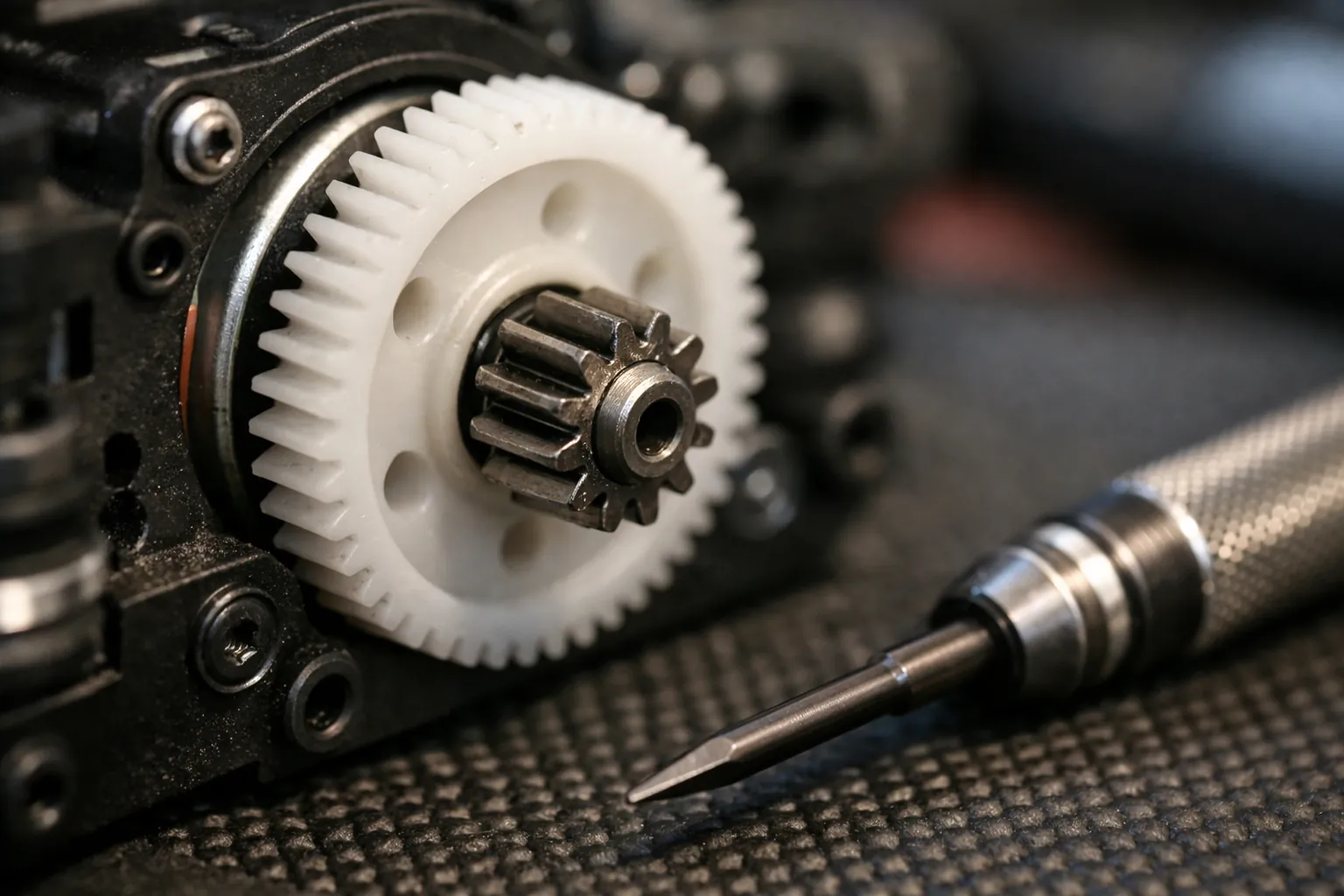
- Final drive ratio (FDR) = spur teeth ÷ pinion teeth × internal ratio. Traxxas prints exactly this formula in its manuals: "# Spur Gear Teeth / # Pinion Gear Teeth x 2.85 = Final Gear Ratio" for the Slash 4X4, with 2.72 for the 2WD Slash and 6.23 for the X-Maxx (Slash 4X4 VXL manual, X-Maxx manual).
- Motor rpm with no load = kV × battery voltage. kV is rpm per volt with nothing attached to the motor. Our guide to motor kV covers why that matters.
- Wheel rpm = motor rpm ÷ FDR.
- Speed = wheel rpm × tire circumference (π × diameter). In mph that's wheel rpm × π × diameter in inches × 60 ÷ 63,360; in km/h it's wheel rpm × π × diameter in mm × 60 ÷ 1,000,000.
Rollout is the distance the truck moves for one turn of the motor: tire circumference ÷ FDR. Two setups with the same rollout on the same motor and pack have the same theoretical top speed, even on different tires. That's why racers compare rollout instead of pinion counts.
Check the math
To confirm the calculator before trusting it, run this example by hand or open the box below.
Worked example: 3500 kV, 3S, 18/54, 2.85 internal, 110 mm tire
These inputs match a Traxxas Slash 4X4 VXL wearing its included 18T pinion (Velineon 3500 kV motor, 2.85 internal multiplier from the manual). Two caveats: Traxxas marks that 18T for NiMH only, and 110 mm is an example tire size we chose, not a Traxxas figure.
- Volts: 3 cells × 3.7 V = 11.1 V
- Motor rpm: 3,500 × 11.1 = 38,850 rpm
- FDR: 54 ÷ 18 × 2.85 = 8.55
- Wheel rpm: 38,850 ÷ 8.55 = 4,543.9 rpm
- Circumference: π × 110 mm = 345.58 mm
- Theoretical speed: 4,543.9 × 345.58 × 60 ÷ 1,000,000 = 94.21 km/h, which is 58.54 mph
- Real-world estimate at 0.85: 58.54 × 0.85 = 49.76 mph
- Rollout: 345.58 ÷ 8.55 = 40.42 mm per motor turn
- Same setup on a fully charged pack (3 × 4.2 V = 12.6 V): 66.45 mph theoretical
Enter 4.33 in instead of 110 mm and you get 58.5 mph, because 4.33 inches is 110 mm to within a fraction of a millimeter.
Why there are two speeds
The theoretical number assumes the motor spins at its no-load rpm while pushing a truck through air and over dirt. It doesn't. Under load the motor slows, and the drivetrain and tires take a cut. So every calculator figure is a ceiling.
The real-world line multiplies the ceiling by an efficiency factor. We default it to 0.85 because one number is more useful than a vague "it'll be lower", but 0.85 is our planning assumption. No manufacturer publishes it, and we haven't GPS-tested trucks to derive it. If you own a GPS meter, run a pass, divide your reading by the theoretical figure and put your own factor in the box.
Two things push real results the other way. A fully charged LiPo sits at 4.2 V per cell (switch the voltage menu to see that peak), and many tires grow at speed. Traxxas's own claims show how this plays out. The calculator gives the X-Maxx 42.1 mph theoretical on 8S with stock 15/54 gearing and its 8.4-inch tires, and the manual says "40+ mph" for that setup. With the included 18/46 set it says 59.2 mph theoretical and about 50 mph at 0.85, where Traxxas claims "50+ mph". The Maxx 4S runs the other way: 47.8 mph theoretical at nominal voltage against Traxxas's "55+ mph out of the box", which only the fully charged figure (54.3 mph) gets near. Traxxas doesn't say how it measures, so read any single claim as a best run.
Reading the pinion swap table
The table under the results reruns the same setup with three pinions smaller and three bigger. Each tooth up is a few percent more top speed and more load on the motor and ESC. Each tooth down costs speed but cools things off and sharpens acceleration, which suits grass or sand.
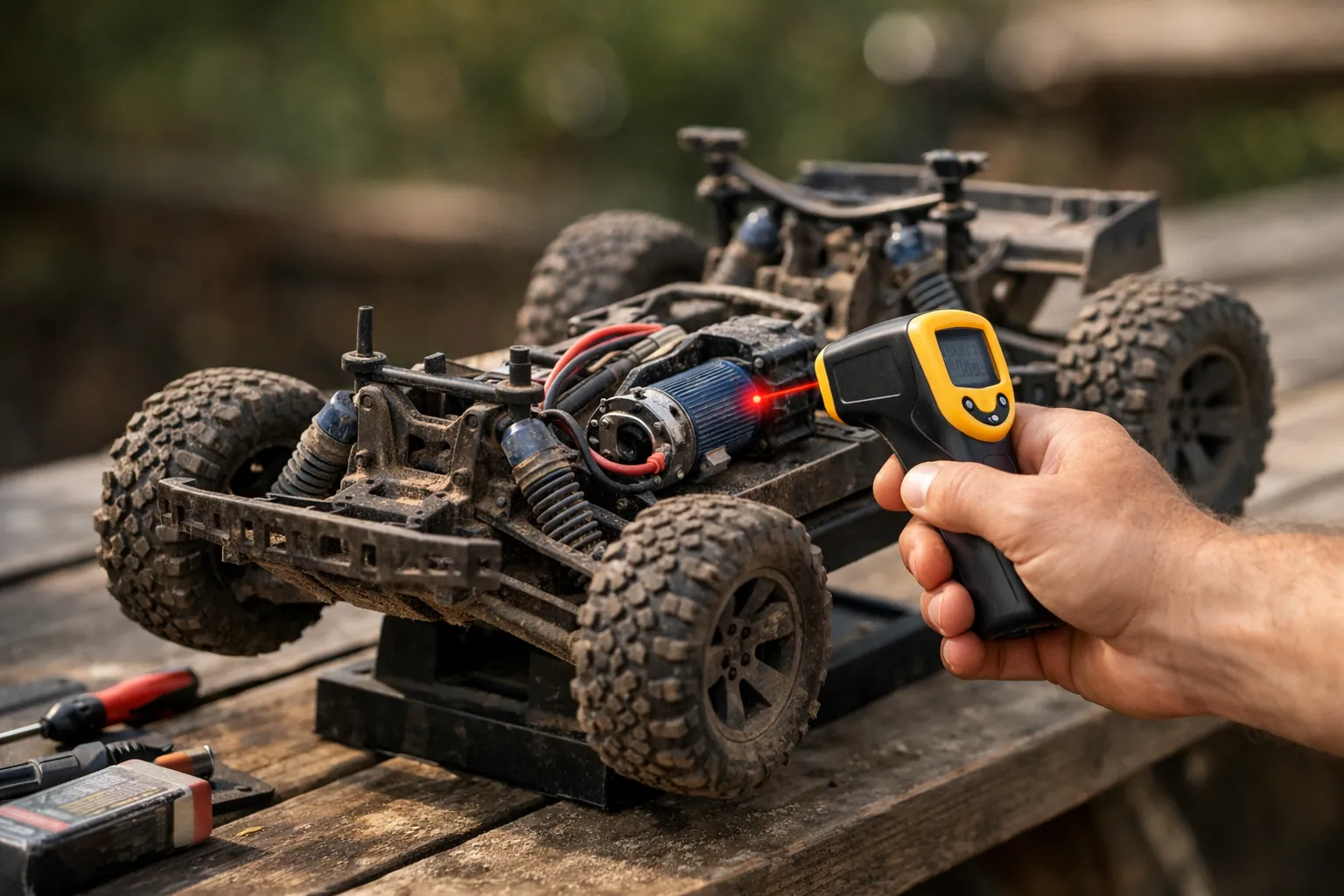
Overgearing is the usual way people cook a motor. The calculator can't measure heat, so it doesn't invent a temperature limit. Do what the manuals say instead: change one tooth at a time, run two or three minutes, then check the motor and ESC. Traxxas also says not to gear by temperature when running in water, because the water cools the can and hides the problem.
With a preset loaded, the calculator warns when you go outside the pinion range on that maker's chart, above the cell count its ESC is rated for, or above stock gearing. Our explainer on pinion and spur gears covers pitch and mesh, plus how to swap a pinion without stripping the spur.
Where to find each number
| Input | Where it lives | Gotcha |
|---|---|---|
| Motor kV | Motor label, product page or manual spec table | Brushed motors are rated in turns, not kV. Tick "brushed" and enter rpm if the maker publishes it. |
| Battery | Pack label: cell count (2S, 3S) and chemistry | Two 4S packs in an X-Maxx make 8S. Pick "8S (2 × 4S)". |
| Pinion and spur | Printed on the gears, or the manual's gearing chart | Count teeth if the print has worn off. |
| Internal ratio | The multiplier in the manual's final-drive formula | Some product pages put the stock final drive in the "internal ratio" field. If it reads 11 or 12 on a 1/10 truck, it's probably the final drive. |
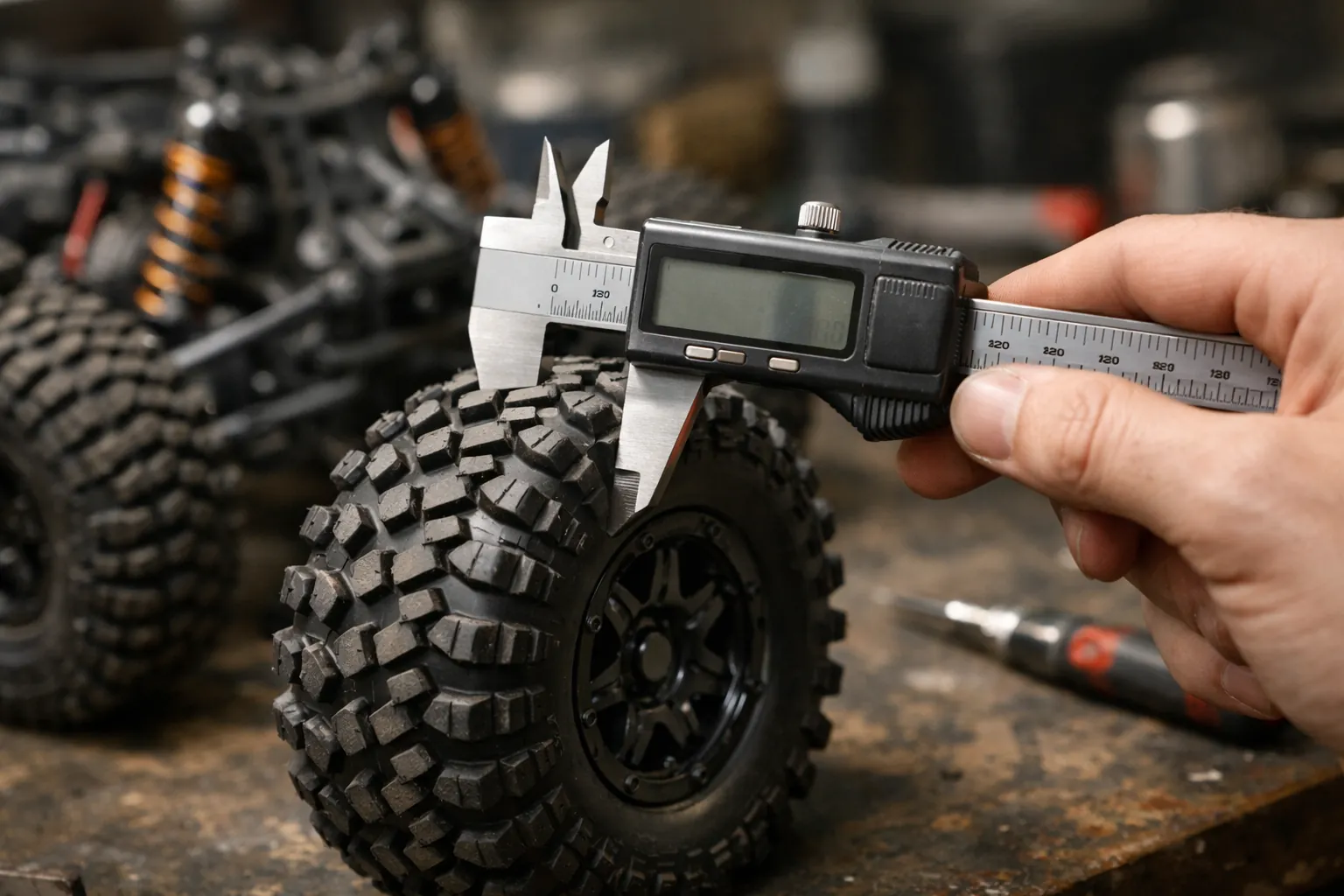
| Tire diameter | Measure it | Most makers list wheel size (2.2", 2.8"), not tire size. Measure across the tread with the truck on the ground. |
What the calculator can't tell you
- Whether your ESC and motor survive the gearing. That's the job of the maker's chart and a temperature check.
- Speed with a two-speed transmission. Enter the internal ratio of the gear you want to check.
- Brushed motor rpm. Few brushed motors publish kV, so brushed mode needs an rpm figure from the maker.
- Traction. A 2WD truck on loose dirt never reaches the number; a 4WD on pavement gets closer.
Parts for the setup you just ran
A pinion swap is the cheapest speed change in RC. Match the pitch (32P, 48P or Mod 1) and the bore to your motor shaft before you buy: a 5 mm motor shaft won't take a 3.175 mm (1/8 inch) pinion. If the calculator says more cells, check your ESC rating first, then see the best RC car batteries for packs. Going from brushed to brushless? Start with brushless vs brushed.
- 32P on a 5 mm shaft (Traxxas VX3 and Velineon trucks with 5 mm motors, many 1/8 trucks): OGRC 32P 5 mm pinion set, 17T to 21T or the smaller 32P 5 mm set, 13T to 17T. Both listings say 32P is the same as 0.8 module.
- 32P on a 3.175 mm (1/8 inch) shaft: OGRC 32P 15T to 19T set. Note the Velineon 3500 and BL-2s motors have a 3 mm shaft per Traxxas, so check yours before ordering a 1/8 inch bore.
- 48P on a 3.175 mm shaft (common on brushed 2WD trucks): 48P 19T to 23T set, which comes with a screwdriver.
- Mod 1 on a 5 mm shaft (big 1/8 and 1/5 trucks): Surpass Hobby Mod 1 pinions, 18T to 22T.
- For the heat check after each change: an Etekcity infrared thermometer, one of Amazon's best-selling temperature guns this month.
Model-by-model speed tables, with the maker's claim and the battery each claim needs, are on these pages: Traxxas Slash top speed, Arrma Granite top speed and X-Maxx gearing and top speed.
Formulas and presets checked against Traxxas and Arrma owner's manuals and product pages on October 3, 2026. The 0.85 efficiency factor is BashBench's assumption. How we research · Affiliate disclosure