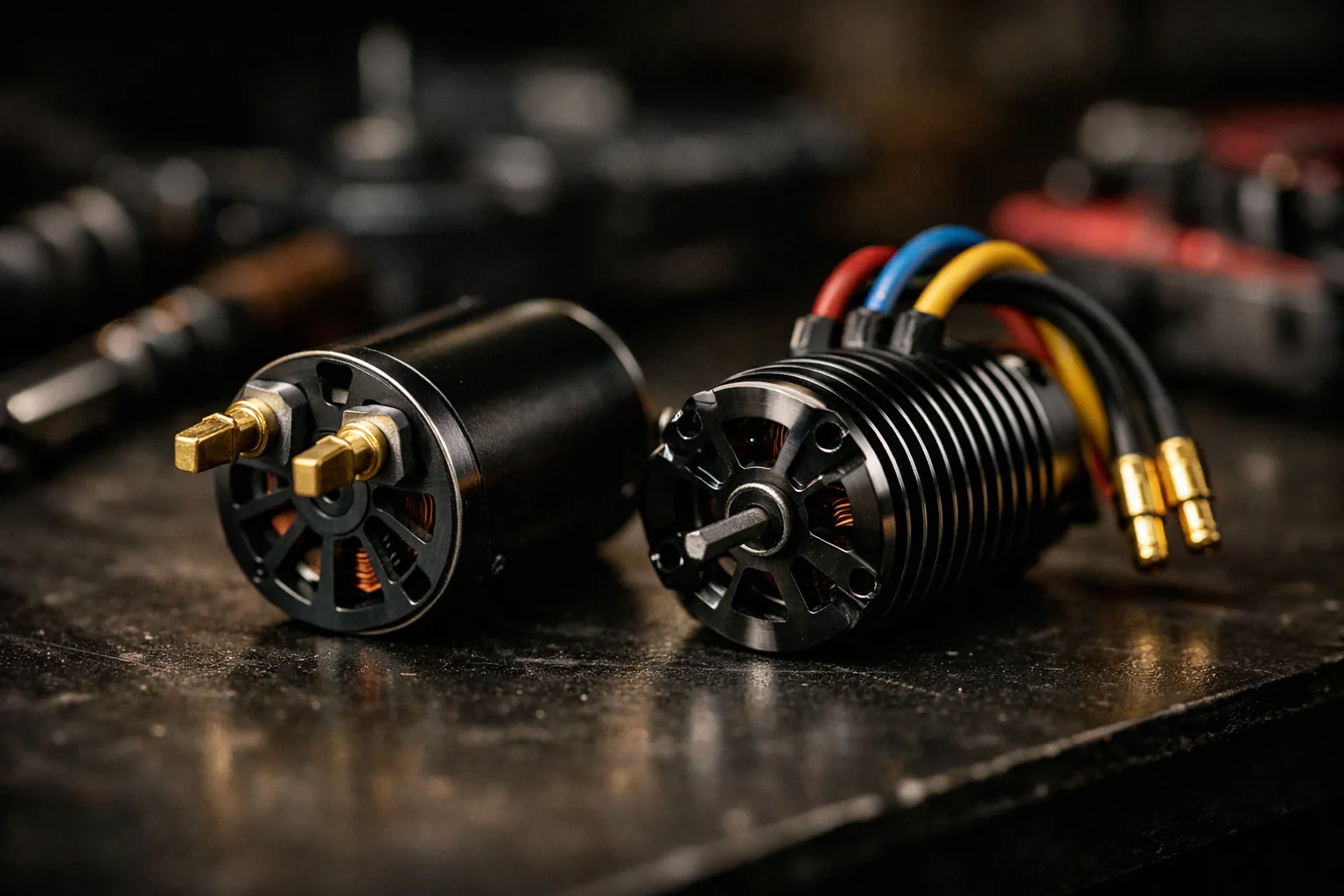
Pick brushless if you want speed; pick brushed if you want low cost and gentle control. Brushless motors are faster and more efficient, and there are no brushes to wear out. Brushed motors cost less and are smoother at a crawl. For a young driver, a tight budget or a slow crawler, brushed is often the better buy.
How we put this together
We worked from manufacturer listings for trucks sold both ways (Arrma's brushed and brushless Mojave GROM, Traxxas's brushed Bandit and brushless Mini Maxx) and from Amazon sales data for motor/ESC combos, all checked October 3, 2026. Speeds and specs below are what the manufacturers state; we didn't run these trucks. How we research.
How each motor works
An electric RC motor spins because the coils are switched on and off in sequence, so the magnets keep pulling the rotor around. The two types differ in what does the switching.
In a brushed motor, carbon brushes press against a spinning commutator and switch the coils mechanically. It's cheap, and it runs on two wires from a basic ESC. The price is wear: the brushes grind down with use, and the friction eats power. Brushed motors are rated in turns. Traxxas's Bandit uses a 12-turn Titan and the TRX-4 Sport a 21-turn Titan. Fewer turns generally means faster; more turns means more torque.
A brushless motor has nothing rubbing. The ESC switches the coils electronically through three wires, so less energy turns into friction heat, the motor makes more power for its size, and there are no brushes to replace. Brushless motors are rated in KV, which our RC motor KV guide explains.
Brushless vs brushed at a glance
| Brushed | Brushless | |
|---|---|---|
| Speed and power | Lower | Higher |
| Efficiency and runtime | Lower: friction and heat | Higher |
| Maintenance | Brushes wear out; motor eventually replaced | Bearings only |
| Cost | Lower | Higher |
| Low-speed smoothness | Very smooth | Smooth if sensored; can cog if sensorless |
| Rating | Turns (e.g. 12T, 21T) | KV (rpm per volt) |
| Battery | NiMH or LiPo (check ESC) | Usually LiPo for full performance |
| Best for | Kids, budget trucks, many crawlers | Bashers, speed, racing |
The same truck, both ways
Arrma sells the Mojave GROM with either motor, which makes it the cleanest comparison we found:
| Mojave GROM (brushed) | Mojave GROM 223S BLX (brushless) | |
|---|---|---|
| ESC | Spektrum SLT 2-in-1 25A, waterproof | BLX brushless system |
| Battery | 2S LiPo + Smart charger included | 2S or 3S, not included (IC2-compatible) |
| Speed | Speed limiting at 50% or 75% from the transmitter | 35+ mph on 2S, 50+ mph on 3S (claimed) |
| Stability aid | Check listing | Spektrum DSC + throttle limiting |
| Who it's for | New and younger drivers | Drivers who want real speed |
Traxxas splits it by size instead. The brushed Bandit XL-5 has a 12-turn Titan motor, comes with NiMH and is listed at 35+ mph. The brushless Mini Maxx uses the BL-2s system with a 2S LiPo included and is listed at 30+ mph from a much smaller truck. Arrma's 1/10 Gorgon is another same-truck pair: our Gorgon review compares the brushed Mega 550 version with the brushless 223S.

When brushed is the better choice
Buy brushed for a young or nervous driver. Less power is the point: the truck is slower, it's cheaper when something snaps, and it usually runs happily on NiMH.
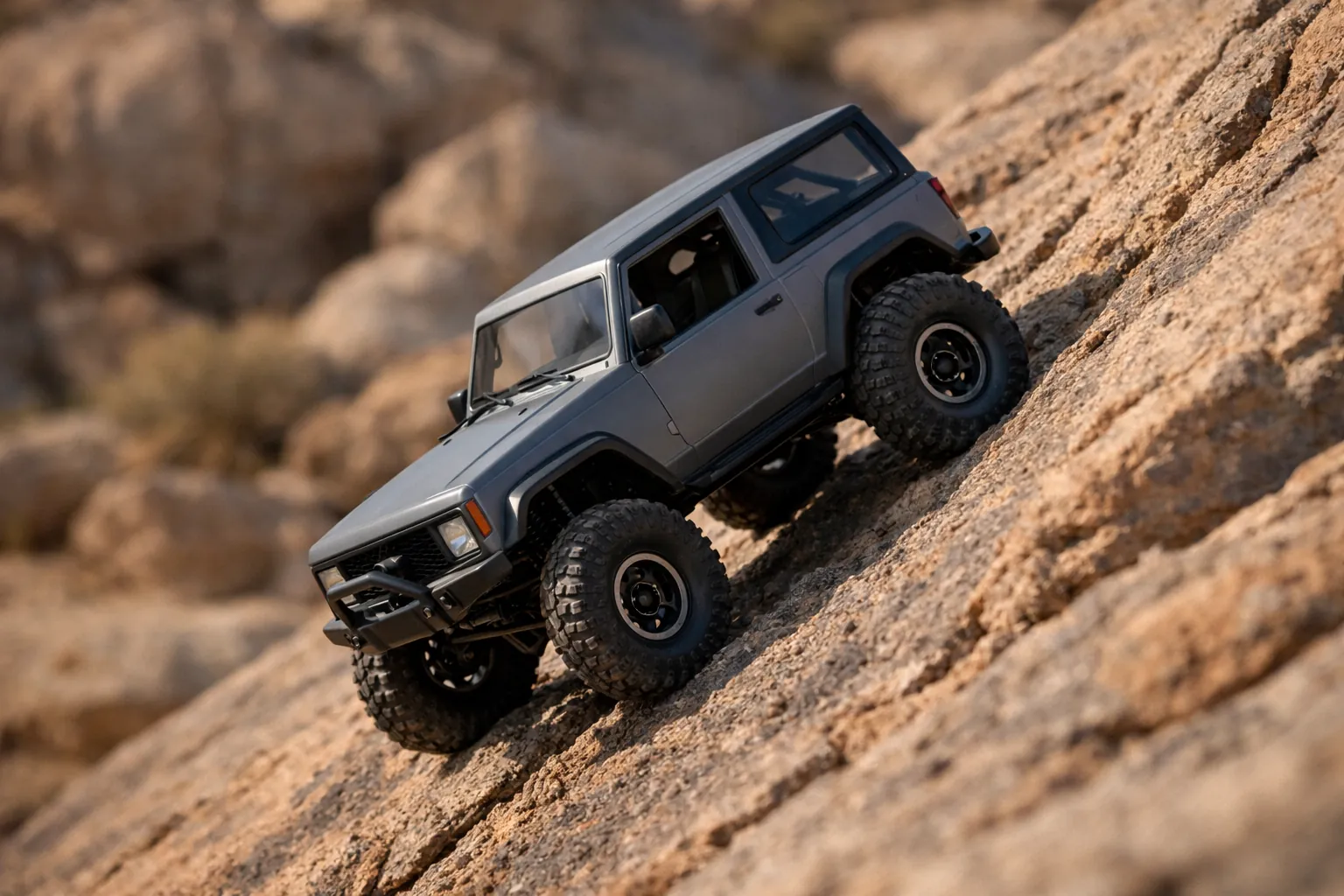
Brushed also makes sense for crawling on a budget. It's smooth at a crawl and inexpensive, and the best beginner crawlers, the SCX24 and TRX-4M included, ship brushed. Torn between the two smallest Axial crawlers? SCX24 vs SCX30 compares size, gearing and batteries.
And if you'll upgrade later anyway, a brushed truck with a good parts supply is a fine platform to convert once you know you're hooked.
Sensored vs sensorless brushless
A sensorless motor has only the three power wires. The ESC works out where the rotor is from the motor's own electrical feedback. That's simple and hard to break, so most ready-to-run bashers use it. The weak spot is very low speed: there's little feedback to read, and a sensorless motor can stutter or "cog" when you pull away gently.
A sensored motor adds a small cable that tells the ESC exactly where the rotor is. You get smoother starts and finer low-speed control, which is why sensored systems dominate racing and why crawler-specific brushless systems exist. You also get one more cable to route and protect, and usually a higher price.
| Use | Best motor type |
|---|---|
| Backyard bashing, jumps, speed runs | Sensorless brushless |
| Track racing | Sensored brushless |
| Rock crawling on a budget | Brushed |
| Rock crawling, upgraded | Sensored or crawler-specific brushless |
| A young child's first car | Brushed |
Brushless and batteries
Brushless systems need LiPo to reach full performance, and many brushless ESCs are rated for 2S, 3S or more. Each extra cell adds voltage and a lot of speed, so check the ESC's rating before you plug in a bigger pack. Brushed ESCs vary more. Some are NiMH-only or have no LiPo low-voltage cutoff, and that matters because over-discharge damages LiPo packs. Traxxas tells owners to always turn Low-Voltage Detection on when running LiPo (Traxxas Battery Basics).
Upgrading from brushed to brushless
A conversion needs a brushless motor and a brushless ESC that match. Buy them as a combo and the compatibility question is answered for you. These are the combos selling on Amazon right now:
- Hobbywing Quicrun Fusion SE 1800KV, a motor with the ESC built in, popular for 1/10 crawlers (300+ bought last month).
- Hobbywing Quicrun WP 10BL60 G2 + 3652SL G2 combo, a waterproof sensorless system for 1/10 bashers.
- Hobbywing sensored G2 combo (10BL120 + 3650) if you want smoother low-speed control.
- Castle Creations Copperhead 1410 3800Kv sensored combo as the premium 1/10 option.
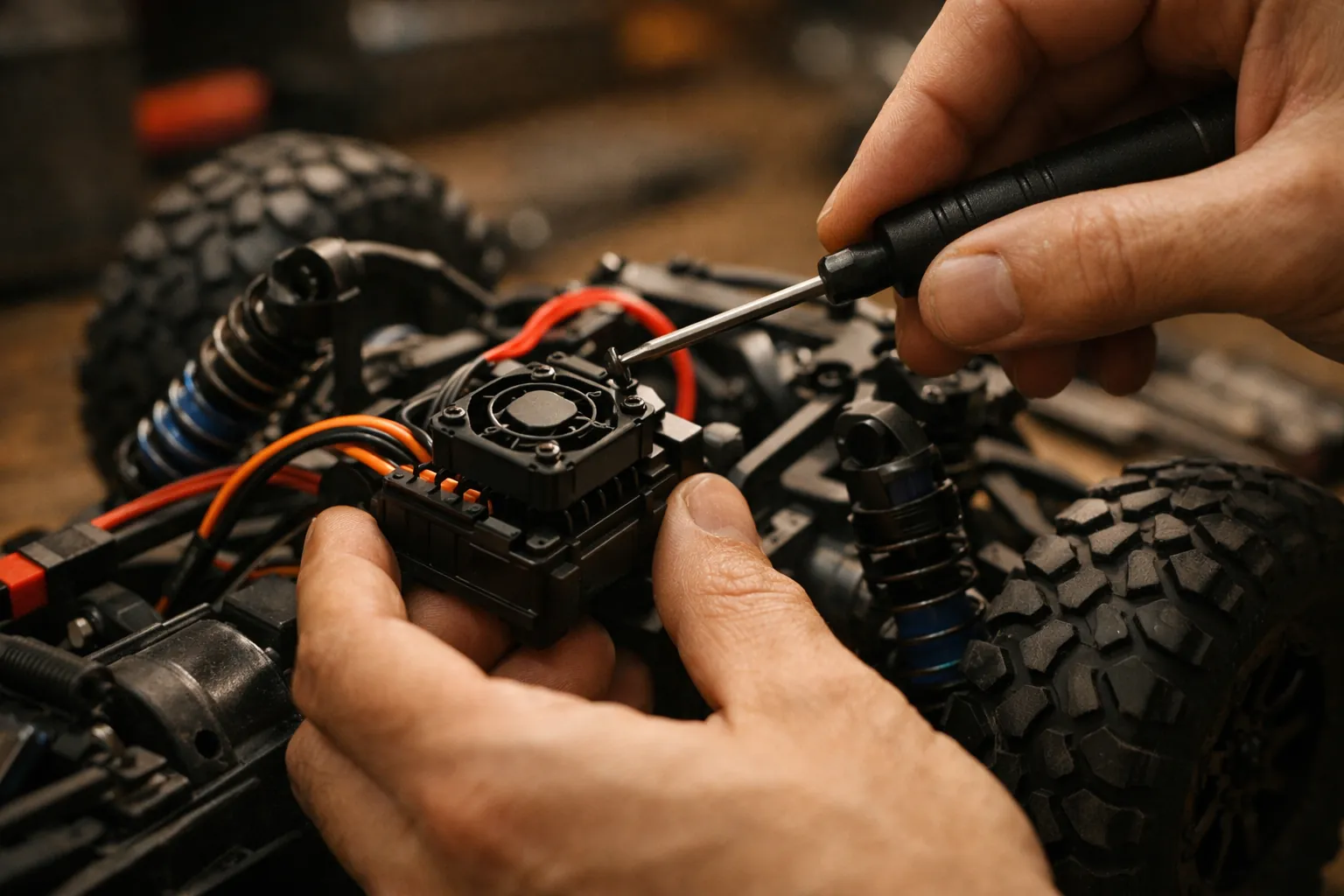
Check fit first: the motor has to suit your motor mount and pinion. Then make sure the ESC supports your battery voltage (2S, 3S or more). The speed control is half of every brushless swap, and our RC ESC explainer covers amps, cells and BEC ratings. Last, be honest about the driveline. Brushless torque finds the weakest gear or driveshaft fast, and our first 5 upgrades list covers what to strengthen. If the swap also moves you to LiPo, set the ESC's low-voltage cutoff and follow the LiPo safety rules. To estimate what a new motor and battery do to speed, use the RC top speed calculator; the pinion and spur gear guide covers the gearing change, and the fastest RC car guide shows where brushless ends up.
Our call
Want speed? Buy brushless now. Converting later costs a motor and an ESC on top of the truck, and often stronger driveline parts too. For a child's truck or a budget crawler, brushed is the simpler, cheaper answer and you won't miss the power. Torn between the two? Get the Arrma Mojave GROM 223S: it's brushless, and throttle limiting lets you start slow and open it up when you're ready. If the real question is electric against an engine, start with our gas vs nitro vs electric guide.
Truck and combo details come from manufacturer Amazon listings, checked October 3, 2026. How we research · Affiliate disclosure