
A bigger pinion makes an RC car faster at the top end and slower off the line, and it makes the motor work harder. A bigger spur does the reverse. That's the whole trade. The rest of this page covers the parts that trip people up: which pitch your truck uses, how to set the mesh, and how to tell whether a swap went too far.
How we put this together
Gear pitches and stock gearing come from Traxxas owner's manuals and parts lists for the Slash and X-Maxx families, checked October 3, 2026, because Traxxas publishes full gearing charts with its own color key. Speed figures come from our RC top speed calculator. Pinion sets below were picked from Amazon's best sellers on the same date, with fitment details taken only from each listing. We describe procedures; we don't claim to have run each gear on a truck. How we research.
What the two gears do
The ratio between them is spur teeth ÷ pinion teeth. A 54T spur and an 18T pinion make 3:1, so the motor turns three times for every turn of the spur. The transmission and differentials multiply that again. Traxxas prints the full formula in its manuals: spur ÷ pinion × 2.85 on the Slash 4X4, × 2.72 on the 2WD Slash, × 6.23 on the X-Maxx. The result is the final drive ratio, and a lower number means more speed.
So adding a tooth to the pinion lowers the ratio (faster), and adding teeth to the spur raises it (slower, punchier). On most trucks one pinion tooth is a bigger step than one spur tooth, which is why people change pinions for big moves and spurs for fine tuning.
One truck, three pinions
The Traxxas Slash 4X4 VXL shows the trade clearly, because Traxxas's manual gives each option a purpose. Speeds are theoretical, at nominal voltage, on an example 110 mm tire (our assumption; Traxxas doesn't publish the tire diameter):
| Pinion / spur | Final ratio (Traxxas chart) | What Traxxas says it's for | 2S | 3S |
|---|---|---|---|---|
| 13 / 54 | 11.82 | Stock, "recommended for most running" | 28.2 mph | 42.3 mph |
| 18 / 54 | 8.54 | Included, "for high-speed NiMH running only" | 39.0 mph | 58.5 mph |
| 19 / 54 | 8.09 | Sold separately, "for high-speed LiPo running only" | 41.2 mph | 61.8 mph |
Traxxas's own speed chart for this truck says 45+ mph on 3S with stock gearing and 60+ mph on 3S with the 19T, which lines up with the theoretical column. Notice what the manual doesn't recommend: the 18T on 3S. The bigger pinion that's fine on a 7-cell NiMH pack is a different load on 3S LiPo. For the full version-by-version picture see Traxxas Slash top speed, and plug your own numbers into the calculator with the Slash 4X4 VXL preset.
Pitch: the one thing you can't get wrong
Pitch is the size of the teeth. A pinion and spur must have the same pitch or they won't mesh, and a mismatched pair strips in seconds. Your manual's parts list names it.
| Pitch | Tooth size | Where you'll see it (from Traxxas specs) |
|---|---|---|
| 64 pitch | Very fine | TRX-4M (Traxxas lists "64 pitch") |
| 48 pitch (48P) | Fine | Slash 2WD XL-5 and Stampede 2WD XL-5 |
| 32 pitch (32P) / 0.8 metric (Mod 0.8) | Medium | Slash 4X4 VXL and BL-2s, VX3 brushless Slash and Stampede. Traxxas labels its 0.8 metric gears "compatible with 32-pitch". |
| 1.0 metric (Mod 1) | Coarse | X-Maxx ("1.0 metric pitch (Mod 1)") and its pinions 6484X to 6491X |
"P" numbers (diametral pitch) count teeth per inch of diameter, so a bigger number means smaller teeth. "Mod" numbers are metric and work the other way: a bigger module means bigger teeth. That's why 48P is finer than 32P but Mod 1 is coarser than Mod 0.8.
Bore is the second number to match. Traxxas's own pinions show how it varies even inside one brand: the Slash 4X4 VXL's 13T is listed as fitting a 3 mm shaft, while the VX3 trucks and the X-Maxx use pinions that fit a 5 mm shaft. Many aftermarket sets are 3.175 mm (1/8 inch). A pinion with the wrong bore either won't slide on or will wobble on the shaft.

Setting gear mesh
Mesh is how deeply the pinion's teeth sit in the spur's. Too tight and the gears bind and heat up. Too loose and the pinion rides on the tips of the spur's teeth until it strips them.
Some trucks take the guesswork away. On the X-Maxx, the manual says "A pin system helps set the motor in the proper place according to the pinion and spur gear that are selected", and Traxxas's chart gives the pin letters for every pair. On the VX3 brushless Slash and Stampede, "A factory installed fixed gear adapter helps set the proper gear mesh." Check your manual first; if it describes a method, use that one.
On trucks with a slotted motor mount, the common method is:
- Loosen the motor screws just enough that the motor slides.
- Fit the new pinion, with its set screw on the flat of the motor shaft if the shaft has one.
- Slide a strip of ordinary paper between the pinion and spur, push the motor in until the gears pinch the paper, and tighten the screws.
- Roll the paper out by turning the spur. You should feel a little free play between the teeth with no tight spots all the way round the spur.
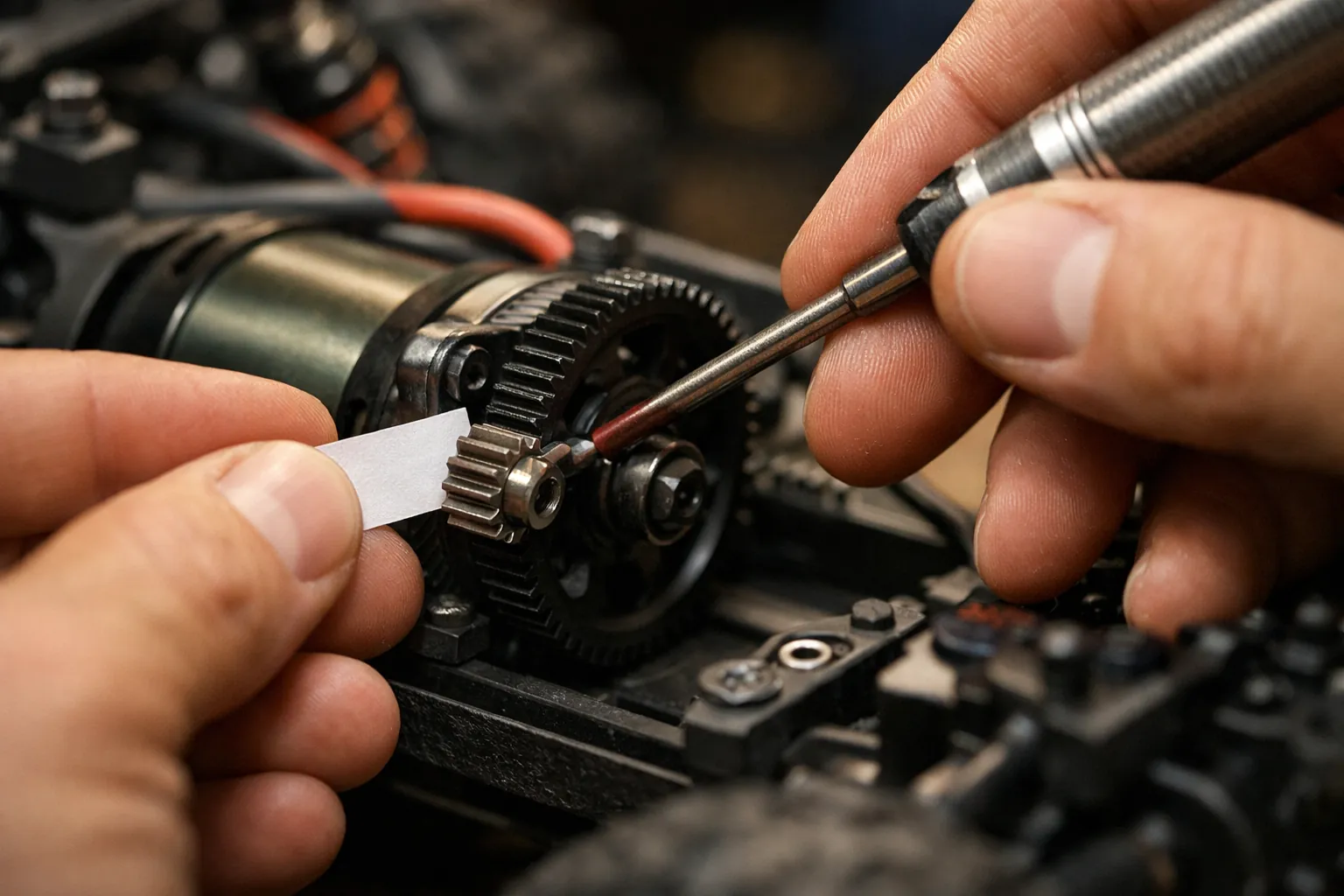
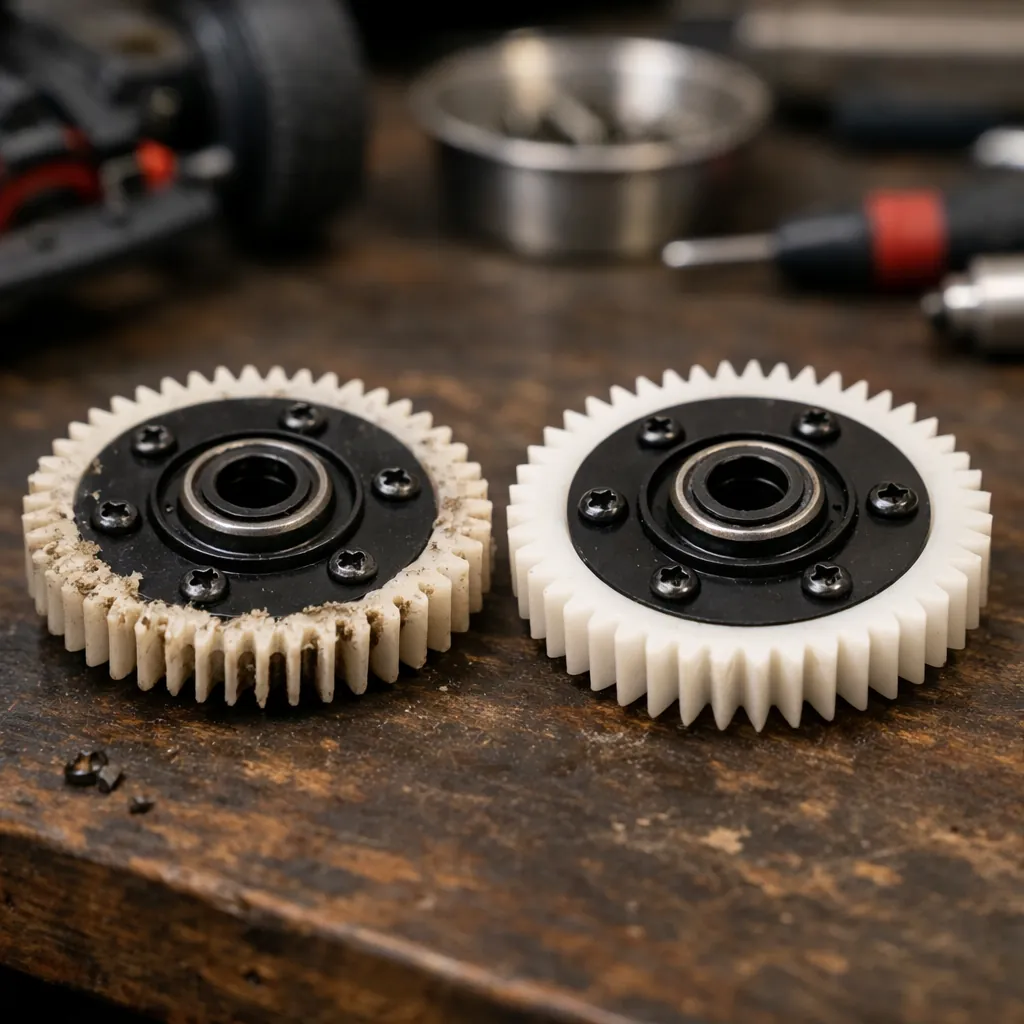
A bigger pinion moves the motor away from the spur, so you have to reset mesh every time you change one. Building a kit means setting it from scratch; our RC car kit guide shows what each kit includes and what you add. A chewed spur like the one below is almost always a mesh problem or a pitch mismatch.
Checking heat after a swap
The calculator can tell you the speed; it can't tell you whether the motor survives it. Change one tooth at a time. Run two or three minutes of normal driving, then check the motor and speed control. If the motor is noticeably hotter than it was on the old pinion, go back a tooth. An inexpensive infrared thermometer turns "feels hot" into a number you can compare run to run.
We don't give a temperature limit here because the limits that matter are the ones your motor and ESC maker publish, and many don't. Two Traxxas rules are worth knowing anyway. For mud and snow, its manuals say to gear down (on the Slash 4X4 VXL "as low as 9T or spur gear as large as 54T"). And "Do not gear the motor by temperature when running in wet conditions", because the water cools the can and hides the load.
Gearing and motor kV go together
A higher-kV motor or an extra battery cell raises motor rpm, which has the same effect as a bigger pinion: more speed, more load. If you've just gone from 2S to 3S, that's already a big step, so leave the pinion stock until you've checked temperatures. Our guide to motor kV explains the rpm side, and brushless vs brushed covers why a brushless system tolerates gearing changes differently from a brushed one.
Pinion sets and tools
Buy a set of consecutive pinions in your truck's pitch and bore rather than one gear. You'll want the tooth below as much as the tooth above. These are strong sellers on Amazon; pitch and tooth counts are from each listing.
- 32P pinion set, 13T to 17T, 5 mm bore. The listing treats 0.8 module and 32 pitch as the same, matching Traxxas's "compatible with 32-pitch" wording; 5 mm suits motors like Traxxas's V3200.
- OGRC 32P pinion set, 17T to 21T, 5 mm bore, hardened steel, for stepping up from a 17T or 18T.
- OGRC 32P pinion set, 15T to 19T, 3.175 mm bore, for 1/8-inch motor shafts. A 3.175 mm bore is not the same as Traxxas's 3 mm, so check your shaft.
- 48P pinion set, 19T to 23T, 3.175 mm bore and the 48P set, 24T to 28T, both with set screws, for 48-pitch brushed trucks.
- Surpass Hobby Mod 1 pinion set, 13T to 17T, 5 mm bore, for Mod 1 trucks such as the X-Maxx.
- Etekcity Lasergrip infrared thermometer, with a 12:1 distance-to-spot ratio, for the heat check after every change.
The short version
Find your truck's gearing chart in the manual and stay inside it. Go up one pinion tooth for speed on hard, flat ground; go down a tooth or two for grass, sand or big tires. Match pitch and bore, reset the mesh every time, and check the motor after a few minutes. If you want to see the numbers before you buy, the calculator's pinion swap table shows three teeth either side of your current setup.
Gearing details from Traxxas manuals and parts lists; product details from Amazon listings, checked October 3, 2026. How we research · Affiliate disclosure