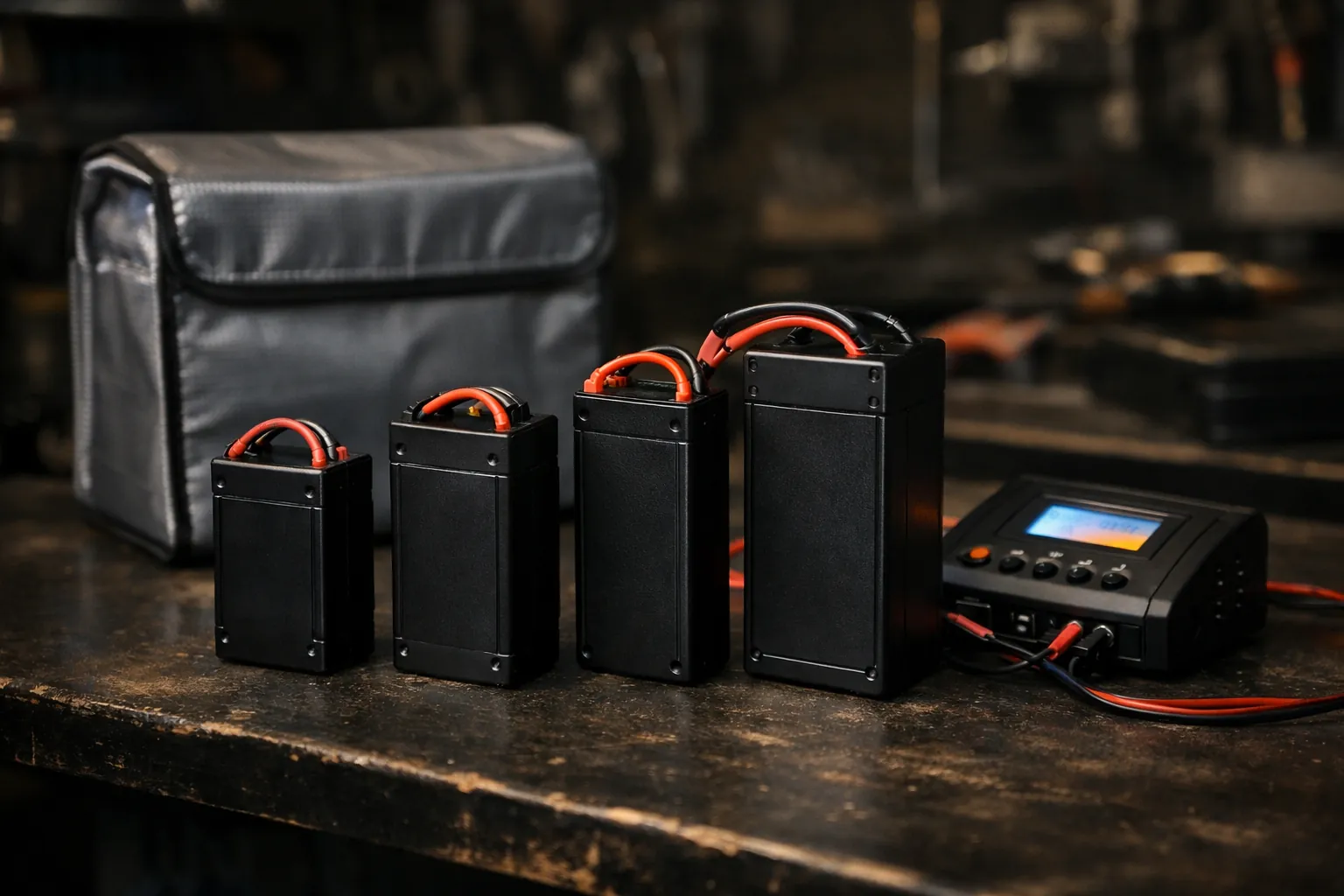
Tape this next to your charger. It answers the three questions every LiPo owner keeps looking up: what a full pack reads, what to store it at, and how low is too low. Every number comes from a Traxxas or Horizon Hobby document, linked below the sheet. Where the two companies publish different numbers, the sheet prints both.
LiPo voltage chart
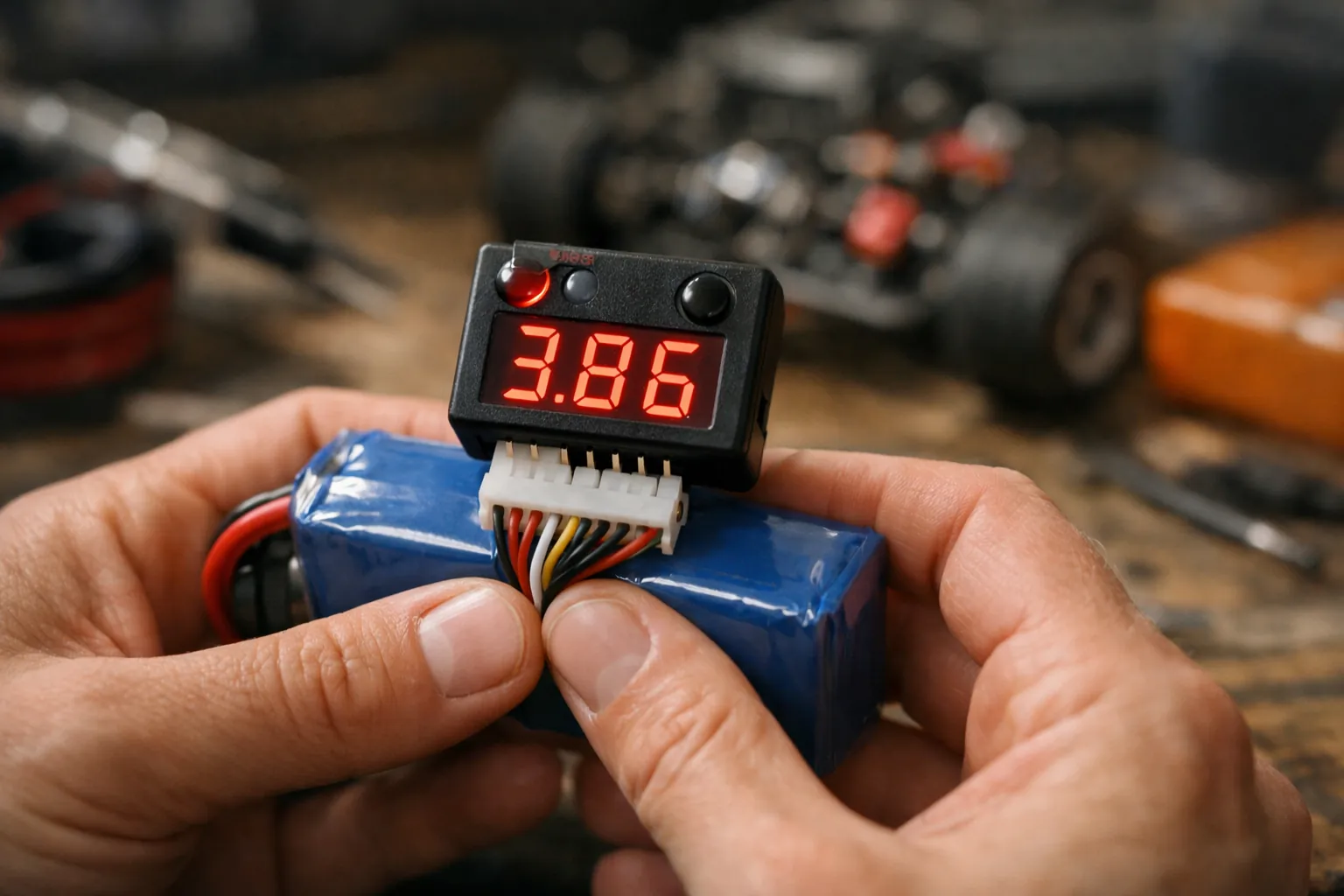
Per cell: full 4.20 V · nominal 3.70 V · storage 3.80 V (Horizon) · cutoff under load 3.2 V (Traxxas LVD) or 3.0 V (Horizon). Multiply by the cell count for the pack. An ESC reads the whole pack, so check single cells through the balance lead.
A. Pack voltages (standard LiPo)
| Pack | Full charge (4.20/cell) | Nominal (3.70/cell) | Storage (3.80/cell) | Traxxas LVD (3.2/cell) | Horizon cutoff (3.0/cell) | Don't charge below |
|---|---|---|---|---|---|---|
| 1S | 4.2 V | 3.7 V | 3.8 V | 3.2 V | 3.0 V | 2.8 V (Traxxas) / 3.0 V (Horizon) |
| 2S | 8.4 V | 7.4 V | 7.6 V | 6.4 V | 6.0 V | 5.6 V / 6.0 V |
| 3S | 12.6 V | 11.1 V | 11.4 V | 9.6 V | 9.0 V | 8.4 V / 9.0 V |
| 4S | 16.8 V | 14.8 V | 15.2 V | 12.8 V | 12.0 V | 11.2 V / 12.0 V |
| 6S | 25.2 V | 22.2 V | 22.8 V | 19.2 V | 18.0 V | 16.8 V / 18.0 V |
| 8S (2 × 4S) | 33.6 V | 29.6 V | 30.4 V | 25.6 V | 24.0 V | Charge each 4S pack on its own |
Storage alternatives: Spektrum Smart auto-storage default 3.90 V/cell; Traxxas says "approximately 50% charged" (Storage mode on iD chargers) and gives no voltage. LiHV packs (Spektrum labels 2S LiHV "7.6V") charge above 4.20 V/cell: use the LiHV setting and the voltage on the pack label.
B. Where a cell sits (at rest)
Only these points are published. E-flite: "approximately 50% charged when it is at 3.8V". No maker we checked publishes a full percentage curve, so this sheet doesn't print one.
C. Before every charge
- Look for puffing, dents, split wrap or loose leads. Swollen or damaged: don't charge.
- Check cell voltages. Below the "don't charge below" column: stop.
- Set chemistry, cell count and voltage to the label.
- Charge rate 1C or less (5000 mAh = 5 A) unless the label allows more.
- Balance lead in the right port, same channel as the power lead.
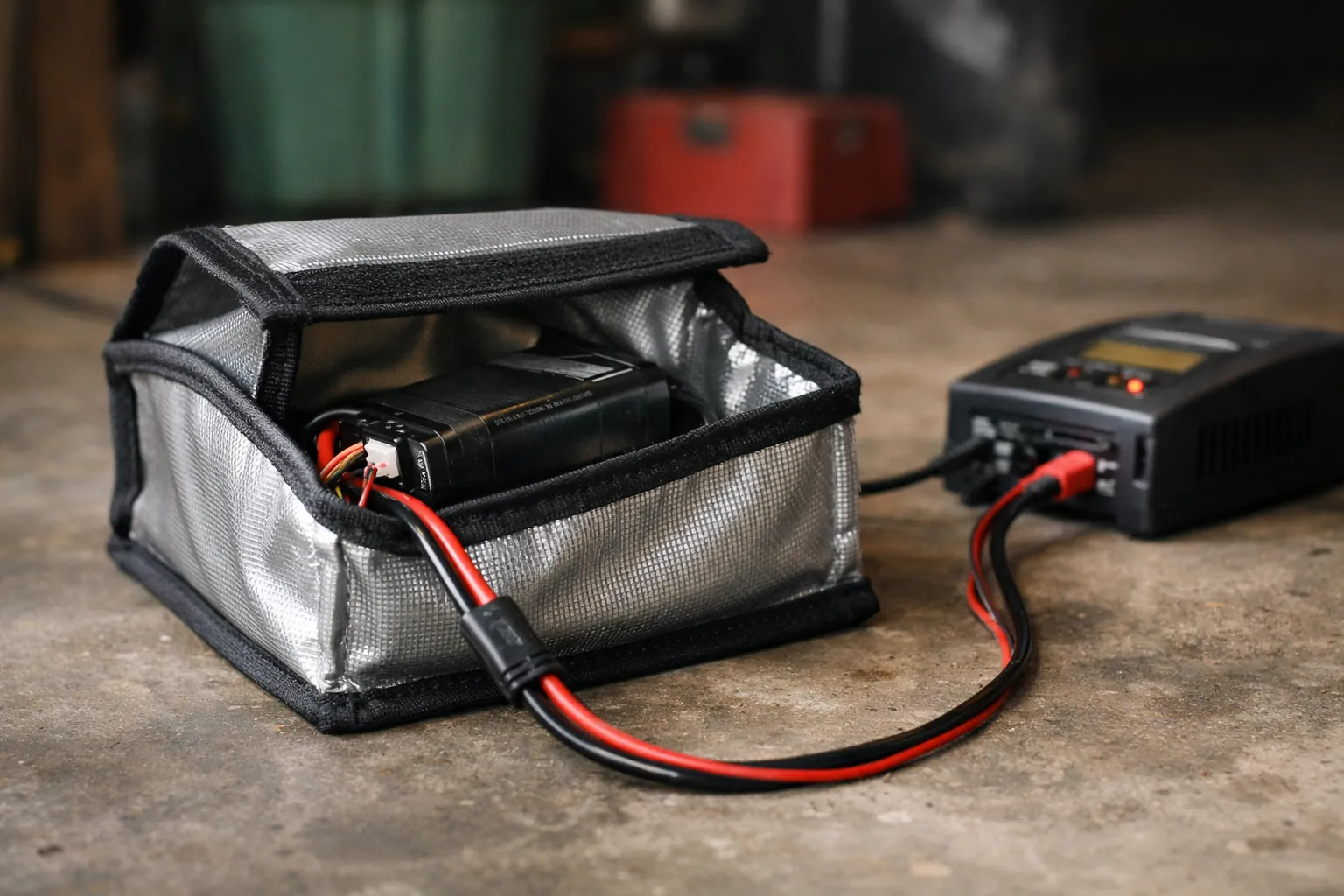
- In a LiPo bag or fireproof box, on a non-flammable surface, never inside the truck.
- Pack between 40 °F and 100 °F. Let a hot pack cool first.
- Stay with it. Never unattended, never overnight.
D. After the run and storage
- Unplug the pack from the ESC as soon as you finish.
- Not running it for a week or more: storage-charge it.
- Store at 40–120 °F (Horizon), never above 140 °F (Traxxas). Never in a car.
- Store packs apart, disconnected, in a non-conductive fireproof container.
- Packs unused for 6 months: check voltage before use.
- Swollen, hot or damaged at any time: stop, disconnect, let it cool. Ask the battery maker how to dispose of it.
- Worn-out packs: lithium-ion recycling drop-off, terminals taped (The Battery Network, formerly Call2Recycle). Damaged packs don't go in drop-off boxes.
Sources: Traxxas Battery Basics and LiPo warning fold-out; Horizon Hobby Lithium Battery Safety 54892 and Spektrum Smart safety sheet 60555.1; E-flite LiPo Battery Guide; Spektrum Smart G2 FAQ; batterynetwork.org. Checked 2026-10-03. Horizon: not for children under 14. Traxxas: no one under 18 should handle LiPo packs without adult supervision. BashBench · bashbench.com/lipo-voltage-chart/
How to use the chart
Find your pack's cell count on the label (the "S" number) and read across. Your charger's storage mode asks for the storage column. The cutoff columns are what your speed control should stop at, measured while the truck is driving. The last column is the floor for charging: a pack that reads below it has been over-discharged, and both companies say not to charge it.
The column most people get wrong is the cutoff. Traxxas and Horizon set it at different points, 3.2 V and 3.0 V per cell, and both are under load. Once you stop driving, the voltage recovers a little, so a pack that tripped the ESC cutoff will read a bit higher on the bench. That's normal. A pack that reads at the cutoff while sitting still has gone too far.
Where every number comes from
| Figure | What the source says | Source |
|---|---|---|
| Nominal 3.7 V/cell | "LiPo battery packs are composed of flat 3.7-volt cells" | Traxxas Battery Basics |
| Full 4.2 V/cell | "Never charge a LiPo battery to more than 4.2 volts per cell"; 2S no more than 8.4 V, 3S no more than 12.6 V | Traxxas LiPo warning fold-out |
| Storage 3.8 V/cell | "store Batteries at approximately 1/2 of the capacity listed on the Batteries' label, or 3.8V per cell" | Spektrum Smart battery safety sheet 60555.1 |
| Storage 3.90 V/cell | Smart battery "auto-storage" default: "72 hours and 3.90V/cell" | Spektrum Smart G2 FAQ |
| Storage about 50% | Store mode makes sure the battery "is approximately 50% charged" | Traxxas Battery Basics |
| Cutoff 3.2 V/cell | Traxxas speed controls alert "when the battery's voltage drops below 3.2 volts per cell" (9.6 V on 3S) | Traxxas Battery Basics |
| Cutoff 3.0 V/cell | "NEVER be discharged to below 3.0V under load"; use an ESC cutoff of 3.0 V per cell | E-flite LiPo Battery Guide |
| Don't charge below | Traxxas: "DO NOT attempt to charge a battery with low voltage below 2.8V per cell." Horizon: make sure voltage "is at least 3V before attempting to charge or use" | Traxxas fold-out; Horizon Lithium Battery Safety 54892 |
| Charge rate | Never above 1C "unless another C rate is specified in the manufacturer's product documentation" | Horizon 54892 |
| Temperatures | Horizon: store at 40–120 °F, don't charge above 100 °F or below 40 °F. Traxxas: storage never above 140 °F, charge between 32 and 110 °F | Horizon 54892; Traxxas fold-out |
The two storage figures look contradictory but sit close together: 3.8 V and 3.9 V per cell are both around half charge, which is what Traxxas asks for without naming a voltage. Pick your charger's storage preset and don't worry about the 0.1 V. An older E-flite safety sheet sets the charging floor higher, at 3.3 V open voltage, which is another reason to treat the charging floor as a hard stop and not a target. None of these numbers apply to cylindrical Li-ion cells, which use a different nominal voltage and cutoff; LiPo vs Li-ion has the side-by-side.
Storage voltage, explained once
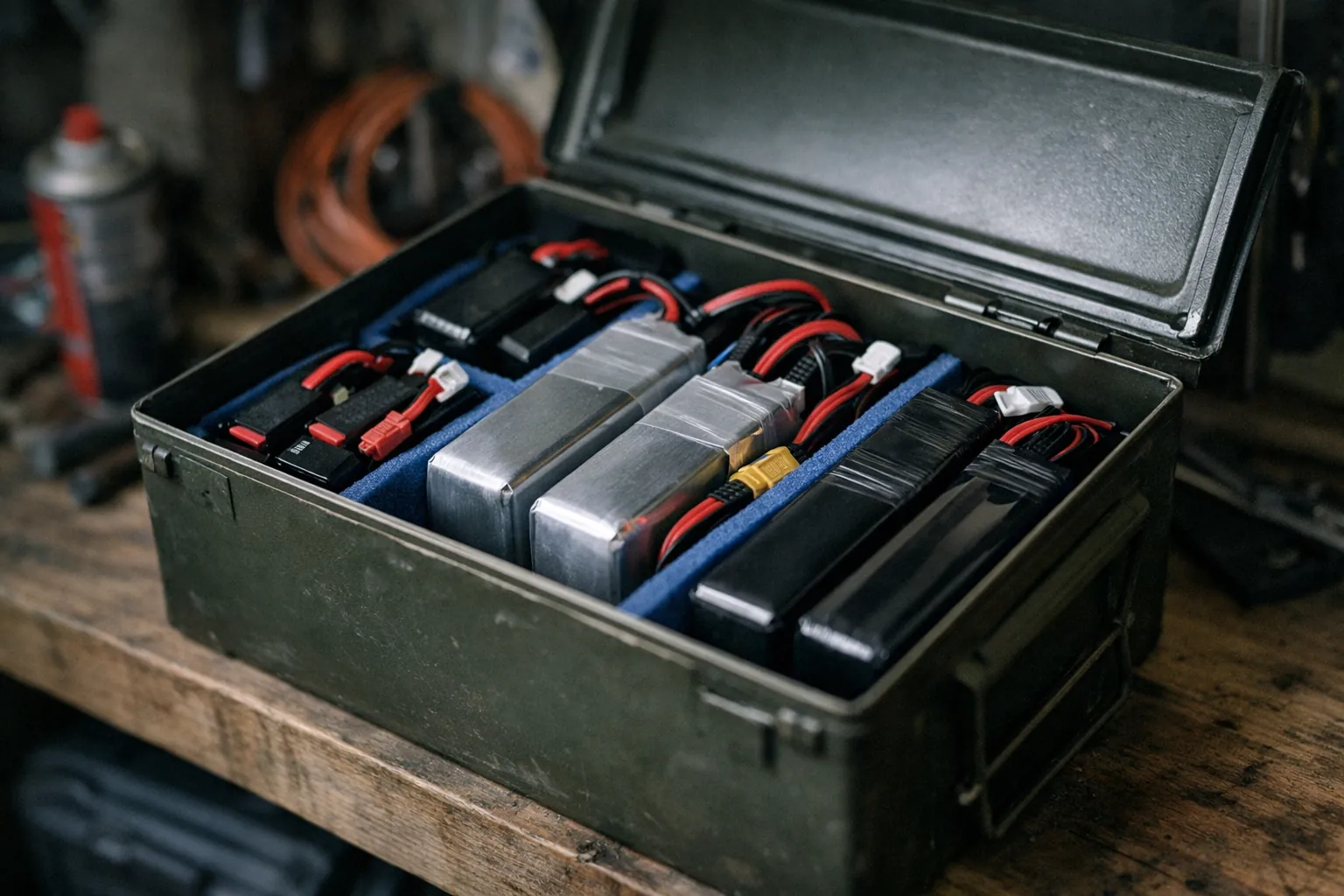
A LiPo left full for weeks ages faster, and one left flat can drop below the point where it's safe to charge. Half charge is the middle ground both companies settle on. Traxxas's chargers have a Storage mode that charges or discharges to that point, and Traxxas says to use it "if you won't use your LiPo battery for a week or more". Spektrum's Smart packs do it on their own after 72 hours unless you turn it off. Which container to keep them in is covered in our LiPo bag and storage guide.
Our guide on how long an RC car battery lasts covers runtime per charge and why storage habits decide how many charges you get. If you're still choosing a charger, every pick in our beginner LiPo charger guide has a storage mode. Pack sizes and plugs for specific trucks: Traxxas Slash, TRX-4M, SCX24 and X-Maxx.
The checklist, and why each line is there
Section C of the sheet is a paraphrase of Horizon's Lithium Battery Safety document, with Traxxas's surface rule added. Two lines cause most of the trouble when skipped. Setting the wrong cell count lets the charger push a pack past 4.2 V per cell, and charging inside the truck puts a possible fire inside a plastic body next to everything else. For the full walk-through, with charge times at 1C, see how to charge a LiPo battery.
Kids and LiPo: Horizon's safety sheet says "Not for children under 14 years", and Traxxas's manuals say no one under 18 should use or handle LiPo packs without a knowledgeable adult. If the truck is a gift, the adult owns the charging.
When a pack is done
Horizon says to dispose of batteries the way your local, state and national laws require. For worn-out but undamaged packs, The Battery Network (the program formerly called Call2Recycle) takes lithium-ion rechargeables at drop-off sites, with the terminals taped or the pack bagged. It does not take swollen, leaking or damaged lithium batteries in its collection boxes. For those, it says to contact the battery maker.
Traxxas's LiPo sheet has its own discharge procedure for retiring a pack, and it conflicts with The Battery Network's advice for damaged batteries. We'd rather not summarize either one into a home method. Use the instructions from the company that made your pack.
The other sheet for your bench
The RC battery connector chart is the companion print-out: every common plug, its maker's current rating and which trucks use it. For LiPo against NiMH in general, start with LiPo vs NiMH.
Figures from Traxxas and Horizon Hobby documents and batterynetwork.org, checked October 3, 2026. How we research · Affiliate disclosure